
Who Decides What? The Rule That Made Our AI Workflow Work

Multi-agent AI systems sound simple in theory: connect a few specialized agents, let them delegate work to one another, and watch the system run.
We tried it, and the biggest problem wasn’t the AI. It was the handoff.
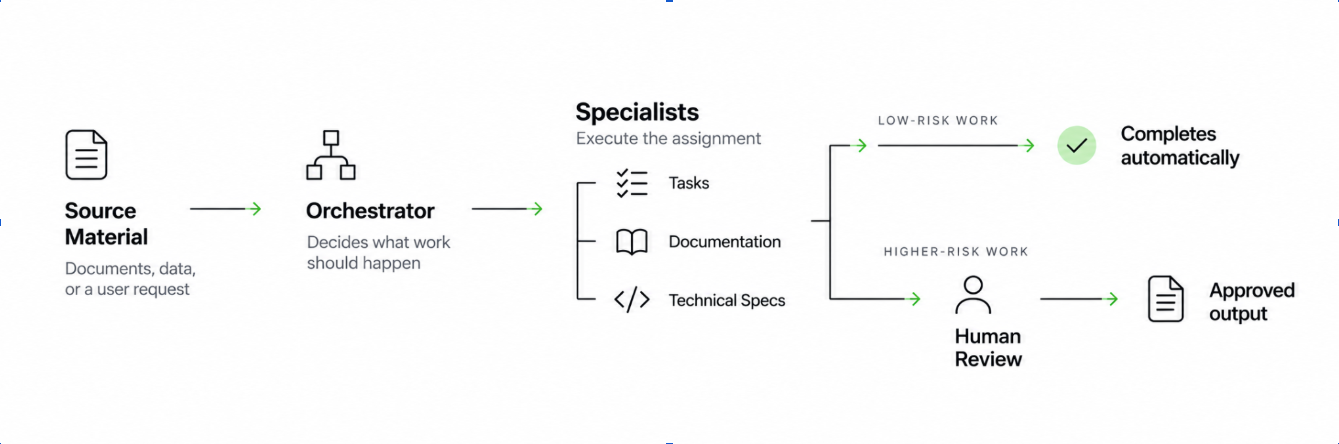
Earlier this year, our team set up an internal AI workflow that could take raw meeting notes, interpret them, and route the resulting work to different specialists — one for tasks, one for documentation, and another for technical specs. A common use of AI, to be sure.
The idea was straightforward: one orchestrator would decide what needed to happen, then hand each item to the right agent.
In practice, agents reinterpreted decisions that had already been made, context disappeared between steps, and failures were difficult to trace. It reinforced something we’ve seen elsewhere with AI integration: starting with the technology instead of the problem often creates complexity before it creates value.
What We Built Instead
Rather than trying to create a self-organizing network of agents, we built a more explicit handoff system.
The orchestrator reads the source material, determines what kind of work is needed, and routes it to the appropriate specialist. The specialist executes the assignment but does not reconsider the routing. That separation turned out to be critical.
Each handoff also includes the context needed to complete the work: requirements, constraints, destination, and open questions. The goal is to give the specialist enough information to do the job well without encouraging it to reinterpret the entire problem.
We also introduced status-based checkpoints.
Low-risk work can move automatically, while higher-risk actions pause for review. Summaries may auto-run. New task creation might deserve a quick human glance. Changes to requirements or client-facing material should receive more scrutiny.
Just as important, every routing decision, handoff, and output stays visible.
When something goes wrong, the team can see where it happened instead of trying to reconstruct a chain of invisible AI decisions.
Why the Handoff Matters
A structured multi-agent workflow gives you a few things a loosely connected swarm does not:
Recoverability. If one step fails, you can rerun that handoff without restarting the entire process.
Auditability. You can see why something was created, changed, or routed somewhere.
Selective autonomy. Low-risk work can move quickly while higher-risk actions stay behind human review.
Human intervention. Someone can add context, change a routing decision, or stop the workflow without breaking the system.
These may not be the most exciting parts of AI system design, but they’re often what separates an impressive prototype from something a business can actually use.
The Orchestrator Principle
The biggest lesson from our work was simple: the orchestrator decides what work should happen; the specialist decides how well to execute it.
When those responsibilities blurred, quality dropped. Specialists started expanding scope, changing targets, or revisiting decisions that had already been made.
The solution wasn’t a smarter agent. It was a clearer boundary. Plus, the human in the loop remained.
Design the Workflow First
If you’re building a multi-agent AI system, start with the workflow before you start adding agents. Ask what information needs to move from one step to the next, which decisions should only be made once, what “done” looks like, and where a human should review the work.
That is also why discovery and architecture matter before AI development begins. If the workflow itself isn’t clear, adding more agents usually creates more complexity, not more capability.
Reliable AI orchestration requires structure: clear ownership, visible state, explicit handoffs, and human checkpoints.
That may be less exciting than a self-organizing network, but it’s also much closer to how dependable systems actually work.
Building AI Into Your Product or Operations?
Outside Source helps teams design and build practical AI systems, connected products, and operational workflows that can actually scale.
Let’s talk about where AI could create real value in your product or workflow.